London’s streets tell a story. From elegant terraces circling leafy garden squares to grand bays and decorative brickwork, the capital is a patchwork of architectural history. Walk along almost any London road and you’ll see centuries of design sitting side by side, but can you tell which era your home comes from?
If you own, or admire, a period property, understanding whether it’s Georgian, Victorian or Edwardian can unlock fascinating details about how it was built, how it was meant to be lived in, and what makes it special today.
Georgian Properties (1714–1837)
The Georgian era spans the reigns of George I through to George IV and broadly covers the 18th century, extending into the early 19th century. This was a time when architecture shifted towards elegance, balance and proportion.
Georgian homes were designed to feel spacious and refined, with generous room sizes, high ceilings and an emphasis on natural light. This was a clear contrast to the darker, more cramped homes that came before.
Many iconic London developments from this period were designed by celebrated architects such as John Nash, whose work includes Regent’s Park terraces and the original design of Buckingham Palace.
How Georgian homes were lived in
Georgian townhouses were very hierarchical. The grandest rooms were on the ground and first floors, where the family entertained guests. Bedrooms often occupied the first and second floors, while servants lived above. This explains why the upper storeys typically have lower ceilings and smaller windows. Kitchens were usually located in the basement, well away from the main living spaces.
One curious feature you might notice on a Georgian property is a bricked-up window. This dates back to the infamous window tax, introduced in 1696. The more windows a house had, the more tax the owner paid, so many homeowners simply blocked them up. Even after the tax was abolished in 1851, many of these windows were never restored.
Key characteristics of Georgian properties
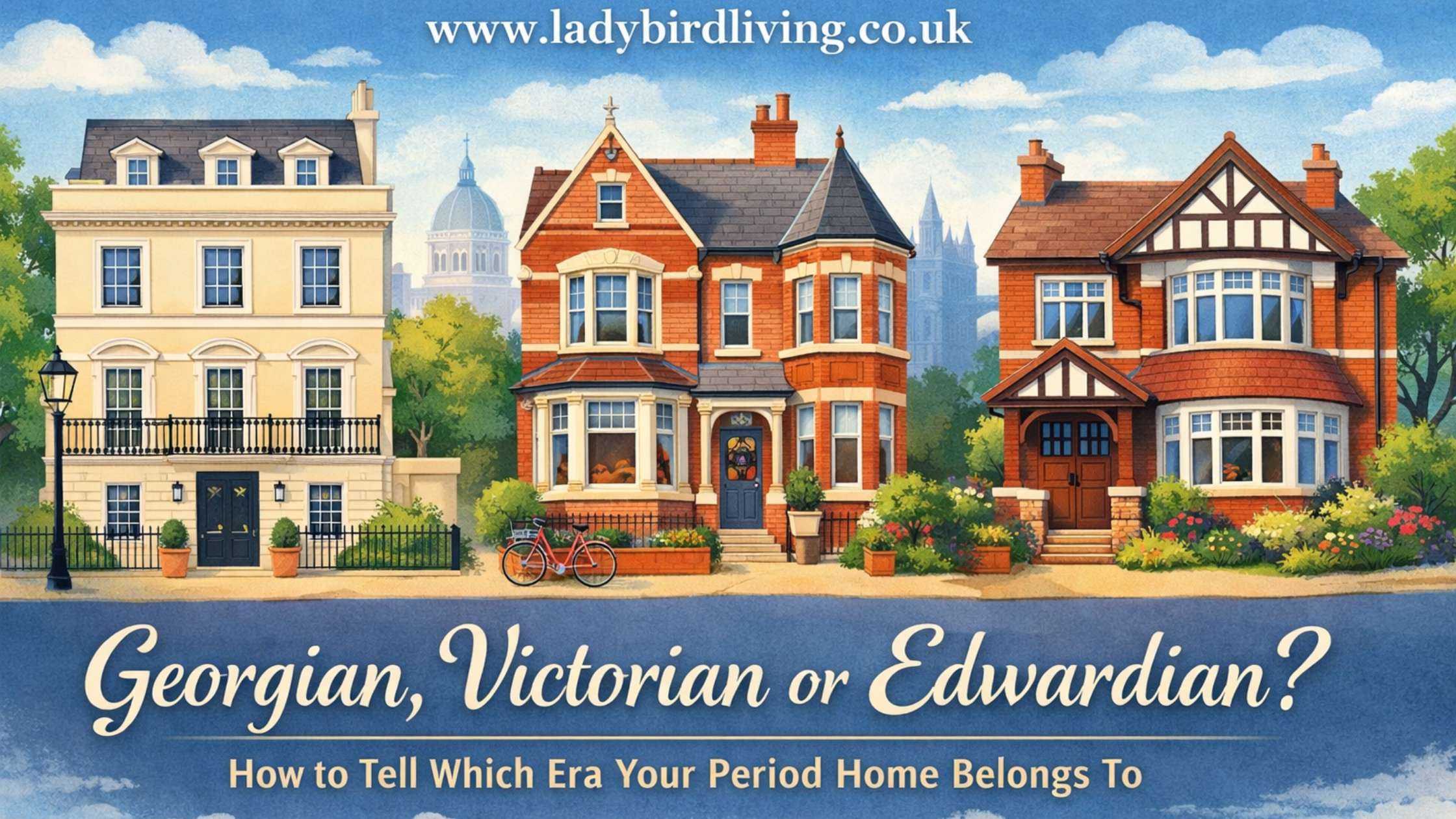
- Three or four storey townhouses
- Symmetrical façades and balanced layouts
- Tall sash windows on lower floors, smaller windows above
- Brick or stucco exteriors, often painted white or cream
- Built around communal garden squares rather than private gardens
Victorian Properties (1837–1901)
The Victorian period coincided with huge social and economic change. As the Industrial Revolution gathered pace, wealth spread beyond the aristocracy and the demand for housing soared.
While earlier homes were largely reserved for the wealthy, Victorian housing was built for a growing middle class. This resulted in the rows of terraced homes that now define many British towns and cities.
Although terraced housing existed before this era, it was during the Victorian period that it was produced on a massive scale. Homes were often built quickly and cheaply near factories, sometimes with little consideration for space or sanitation. Later reforms outlawed the worst of these practices, leading to the more familiar Victorian terraces we see today.
Inside a Victorian home
Victorian houses often have high ceilings and large windows, but their layouts tend to be narrower and more compact than Georgian homes. Many are just one room wide, with a long hallway running from front to back and rooms branching off. Fireplaces were common in almost every room, reflecting both practicality and status.
Key characteristics of Victorian properties
- Coloured or red brickwork
- High-pitched roofs and ornate gables
- Bay windows and brick porches
- Narrow hallways
- Decorative tiled entrances
- Stained glass details
- Fireplaces in most rooms
- Patterned wallpaper and dark wood finishes
Edwardian Properties (1901–1914)
The Edwardian period was short but influential. Reacting against Victorian mass production, the Arts and Crafts Movement encouraged simpler design, craftsmanship and a closer relationship with nature.
By this time, central London was becoming crowded, so new homes were increasingly built in the suburbs. This gave rise to the garden suburbs, such as Hampstead Garden Suburb, where space, light and greenery were key selling points.
Edwardian houses were typically wider and lower than Victorian terraces, with bigger rooms, wider hallways and more windows. Many were set back from the road with front gardens, reflecting a growing desire for privacy.
Key characteristics of Edwardian properties
- Red brick exteriors
- Wide hallways and larger rooms
- Front gardens and recessed entrances
- Decorative porches with timber frames
- Mock-Tudor detailing on upper floors
- Parquet wood flooring
- Brighter interiors and simpler decoration
Why knowing your property’s era matters
Understanding the era your home was built in isn’t just about architectural curiosity. It can influence everything from renovation choices to buyer appeal. Original features, proportions and layouts all tell a story, and preserving them can add both character and value.
Whether your home is Georgian grandeur, Victorian charm or Edwardian elegance, each period has left a lasting mark on the UK housing landscape and that is exactly what makes period property so enduringly desirable.